Menu:

Published 10/18/09
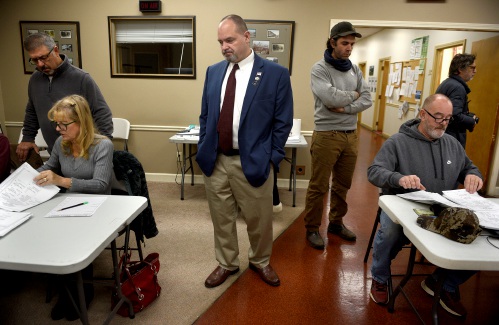
Retired surveyor John Dutton, of Bethel, examines 1895 property records in the Bethel town clerk’s office while working on the town’s ancient roads report on Friday. Dutton is doing research in seven area towns to document their ancient roads, part of legislation passed in 2006. The deadline for documentation of the roads is February 2010. (Valley News — Geoff Hansen)

Vermont's Lost Highways

By Bob Hookway
Valley News Staff Writer

Those surprised at how difficult it can be to find something lost along a road might consider an even more difficult challenge facing Vermont towns this fall: finding the roads themselves.

These are not the paved and plowed highways used by commuters each day. They are the “ancient roads” that have disappeared because they fell into disuse, and the passing of time has made them all but undetectable, except in the musty offices where town records are kept.

Searching the woods or town office file cabinets for evidence of those roads has become an increasingly common activity in municipalities around Vermont as a deadline approaches for towns to either stake their claim to these ancient roads or forever forfeit them to woods and fields.

The issue is of concern to more than local historians. In a number of instances, ancient roads have been discovered to run through the private property of people who had no clue that a public right-of-way existed. Their opposition to re-establishing the right-of-way -- or the town's interest in claiming it -- has set off pitched battles that have ultimately ended in court.

“I thought Vermont had strong property laws,” said Daniel Wellford, a Bethel resident who battled his town over its insistence that an ancient road existed on his property. “I guess they've turned away from that.”

Wellford's conflict actually dates back to 1996. It was the increasing frequency of such battles that prompted real estate agents, title insurers, lawyers and bankers to pressure the Vermont Legislature to eliminate the confusion.

Vermont title searches are required to go back only 40 years, meaning the existence of older roads was often overlooked, according to the Vermont League of Cities and Towns. Real estate agents worried that if word got out that property transfers were being tangled in ownership issues, prospective buyers would look elsewhere.

In 2006, the Vermont Legislature passed Act 178. The law gives cities and towns the option of researching the ancient roads, holding public hearings, and adding them to town highway maps. Any road not added to the map becomes designated an “unidentified corridor,” and as such will automatically be discontinued as a public road by 2016. Under Act 178, according to a study of the issue published in the Vermont Law Review, “towns essentially have two options regarding their ancient roads: map them or lose them.”

That's what many towns are busy doing now, and the deadline for towns to get them identified is February.

But to actually find even the remnants of these “ancient roads,” as Vermont calls them, by viewing the land itself can be an impossible task, “like sewing clouds,” according to Paul Gillies, a Montpelier attorney and former Vermont deputy secretary of state who has worked extensively on the issue for several years.

Some of the thoroughfares were laid out in the early 18th century -- if they were laid out formally at all -- thus predating Vermont's 1791 establishment as the nation's 14th state.

“You can't see them anymore; most of them were there before 1830,” said Gillies, who has been one of the searchers himself, plowing through town records in Berlin, Vt., where he lives.

Gillies says he loves the historical aspect of it, the discovery of where people traveled in these parts centuries ago. He has also worked as an attorney on the issue, including representing property owners in cases that have made it to Vermont's courts.

“We're looking at 230 years of ignoring road records,” he said. “Nobody's ever had a handle on these roads until now.”

He estimated that 80 of the state's 200-plus cities and towns have responded by having volunteers search for the roads, or have at least appointed committees to gather information.

Some towns, such as Newbury -- which already has more miles of secondary roads than nearly all other Vermont towns -- have simply declared that they have no interest in claiming back any of their ancient roads.

‘A Very Ugly Situation'

Wellford's dispute in Bethel reached the Vermont Supreme Court, which on Sept. 30 upheld a decision in Vermont Superior Court in Woodstock that found in favor of the town. Bethel officials believed the establishment in 1806 of a town thoroughfare called “old town road from Camp Brook to Gilead,” in the town records gave the town a right-of-way through property owned by Wellford and his wife, Paula.

It started when town officials were examining the sufficiency of turnaround spots on Town Highway 34 -- also known as Dunham Road -- for town plow trucks.

The Wellfords had countered in the lower court that the old road had not been created properly, and in any case had been abandoned by the town, which should therefore have no rights to it.

They reasoned that “any attempt to reactivate the road should be treated as an alteration of a town highway,” according to the court record.

But the high court pointed, in part, to a history of the road based on an 1806 land survey, and agreed with the lower court that the thoroughfare -- just under two miles in length -- was a legally established ancient road.

“The trial court sifted through surveys, maps, and expert testimony, and its findings … are supported by this evidence despite the fact that the exact location of the road could not be determined with 100 percent accuracy,” the five Supreme Court justices ruled in their decision.

Wellford said Thursday night that the battle over the road had been an ordeal for him and his wife and it tied up their property for years so that they couldn't have sold it if they'd wanted to. Furthermore, he added, the town’s reckoning of the course of the ancient road is “ridiculous.”

“It goes over my well, through my dining room, across my septic system and through a pond in the back field,” he said.

Asked if the matter had drawn him into conflict with town officials, Wellford replied, “They brought the conflict to me. It was considered as though I was impeding the town and causing problems. They sued me. The whole process is just really unbelievable. It was a very ugly situation.”

Wellford said he spent two months in Montpelier trying to persuade legislators they needed to establish a law that would govern such situations.

Wellford said he and his wife now consider their property value to be damaged, and would have to disclose the ancient road issue to any prospective buyers, “even though we paid full value and full tax rates,” for the parcel, and received no discounts pertaining to its ancient road.

Wellford and Selectboard member Bill Richards were able to agree on at least one point: “It's been a long, drawn-out process,” Richards said in a separate telephone interview Thursday night.

“The town had to spend a lot of money. The road was well established. We couldn't give it up,” said Richards, who denied that its course takes it through the Wellfords' home.

“It doesn't go through his house. And that pond was built after he bought the place.”

Williams said he had not seen the court's five-page ruling, nor had the Selectboard considered it at a meeting yet.

“We'll be going over it, I'm sure. We'll get together with Mr. Wellford, and hopefully we'll work something out,” he said.

Public vs. Private

Identifying and locating the old byways isn't the only issue in play.

As town officials in Corinth have discovered, property owners can be less than enthused at the prospect of having land they'd assumed for years belonged to them suddenly being identified as a public way, claimed by the town and possibly opened up for general use.

“This is going to be talked about for years before it's settled,” said Corinth Selectboard member Laurie Sheridan, who believes the overall issue, statewide, will eventually land in court, not just individual cases such as Bethel's.

“I think it'll have to. I hope it doesn't in Corinth, but I think it will in some of these bigger towns,” Sheridan said. “Some town will put a road on the map that a landowner somewhere doesn't want there, and he’ll take them to court.”

She added that a public hearing on the issue drew 50-60 people to Town Hall in Cookeville earlier this month. The Selectboard made no decisions then, but the members are considering the status of about eight such ancient roads throughout town, including one that covers a long stretch of West Corinth near an abandoned copper mine and the site of the long-defunct Maplewood Hotel.

Sheridan said she came away from that three-hour meeting believing residents and landowners do not want the town to claim most of the old roads, a move that would be likely to set some landowners at odds with town officials.

Which roads, if any, to claim was the subject of much of the discussion, said Sheridan, who said the idea of having a special town meeting on the matter did not appear to be popular one.

The decisions in the end will probably involve no more than a few roads, and will likely be made by the Selectboard, she said.

Unforeseen Difficulties

Stan and Lynn Spencer probably weren't thinking of future legal problems when they bought an old, rundown farm on Town Highway 14, a short, dead-end road northeast of Silver Lake State Park in East Barnard.

At around the same time, however, John Dutton of Bethel had become fascinated with the idea of finding and mapping ancient roads in the area, and was finishing up his work in Barnard.

The former surveyor has since gone on to perform similar research throughout the area, and, dating back to 1987, has testified in court as an expert witness in ancient roads cases.

Early in this decade, the Spencers decided their move to Barnard had been a mistake. They were also wrangling with town officials over their plans to use a field on their place as a private airstrip.

So they agreed to sell their property to a man named David Muller. In 2002 however, Barnard officials published a new highway map based largely on Dutton's efforts. Spencer said someone in town was quick to point out to the Selectboard that, according to the map, a newly discovered ancient road was on the Spencers' property, and things quickly became tangled.

“A claim of an ancient road puts all kinds of stops on anything you're doing. I teach history, and so I believe in this ancient road thing. But people are using it as a zoning tool. It's pretty scary,” said Spencer, who formerly taught at Vermont Academy in Saxtons River.

Among the things halted was the family's sale of the East Barnard property. The Spencers went to court seeking to establish, in part, that the ancient road did not cross their property. The court found the couple didn't prove that, but neither, said the judge, could surveyors and other experts reconcile old maps, surveys and deeds with the physical evidence on the property.

Eventually, Stan Spencer said, the matter was resolved in a way that included the Spencers recovering some compensation through property title insurance.

The court issued a mixed decision, giving each side a partial victory. But the resolution did make it possible for the Spencers to sell their home and leave Barnard, and they now live in Weathersfield.

Act 178

Trevor Lashua, a senior associate for advocacy and information with the Vermont League of Cities and Towns in Montpelier, explained some key points of Act 178.

* Any ancient road a town puts on its map becomes a road like any other. Most of those involved will be Class IV roads. There's also a separate process in general state highway law by which a town can essentially reclassify a road as a legally established trail.

* A town could build or rebuild that road up to a variety of specifications. It's unlikely that most of the roads would become major -- or even minor -- pieces of a town highway network, but it is possible.

* As a town highway, the road would be open for whatever uses are eligible under that classification. The concern is that motorized uses of currently unused Class IV highways or legal trails would suddenly become the norm. But there are things towns can do to restrict ATV use.

Snowmobiles are a different story, in that usage of the town road really depends on whether or not the town plows it.

Even if it doesn't, towns can adopt highway policies under which they can establish hours of operation and speed limits for snowmobile use.

Asked whether a private resident could take a claim to court on behalf of the public, Lashua replied, “I believe the court cases so far have focused, generally, on whether or not a road being added is actually a legally established town highway. The court system, for a landowner who opposes a Selectboard's inclusion of what we refer to as an ancient road on a highway map, … is the venue to ultimately appeal and fight that decision.”

As far as how landowners can learn when town officials are eyeing a possible ancient road on their property, Gillies -- who represented both the Wellfords and the Spencers in their court cases -- said there's nothing in the law that specifies how such notification should be issued.

But he said a municipal board that's acting responsibly would call a public hearing and explain “what's happening to everybody who is interested, well before taking action.”

As frustrating and perplexing as these issues, which involve people's home and property, can become, at least things in the Upper Valley haven't reached the hostility level of a situation in Chittenden, Vt., where state police were summoned to separate landowners and a town crew armed with chain saws and intent on clearing a stretch of land they'd identified as an ancient road.

Dutton, meanwhile, fast closing in on age 71 and a retired math teacher, former surveyor and longtime Bethel resident, says he has taken a strong liking to working on ancient roads issues, which came to the fore 15 or 20 years ago when real estate prices started skyrocketing.

“It all changed in the '90s. Only the very, very wealthy could afford some of these properties.”

And since then, some of those landowners have become very disgruntled upon finding that a town has a right of way through what they thought was their private slice of paradise.

“They were not being told that when they bought. And any piece of land that big probably has several rights of way on them,” Dutton said.

He added that some of the best resolutions he has seen over the years are agreements not to squabble over whether such rights of way exist, but to acknowledge them, then move them to a section of the property that will least inconvenience the landowner, while also accommodating the town should it need to traverse the parcel in question.

They agree to a detour.

“And these issues are shaping up as battles between landowners and the towns. But it's really not the towns. It's the property owner and the general public -- the public of the world -- they are public rights of way. The town can set limits on the maintenance, bridges and culverts, but it's not a town issue at all, although the town is usually the defendant,” Dutton said.

Bob Hookway can be reached at bhookway@vnews.com or (603) 727-3223.

Back to the story index